



Fluctuations and precise deviations of cumulative INAR time series
In this paper, we study fluctuations and precise deviations of cumulative INAR time series, both in a non-stationary and in a stationary regime. The theoretical results are based on the recent mod-
convergence theory as presented in Féray et al., 2016. We apply our findings to the construction of approximate confidence intervals for model parameters and to quantile calculation in a risk management context.
The impact of ROI extraction method for MEG connectivity estimation: Practical recommendations for the study of resting state data.
Magnetoencephalography and electroencephalography (M/EEG) seed-based connectivity analysis typically requires regions of interest (ROI)-based extraction of measures. M/EEG ROI-derived source activity can be treated in different ways. For instance, it is possible to average each ROI's time series prior to calculating connectivity measures. Alternatively one can compute connectivity maps for each element of the ROI, prior to dimensionality reduction to obtain a single map. The impact of these different strategies on connectivity estimation is still unclear.
Aperto un bando per un assegno di ricerca sui fondi PRIN 2022
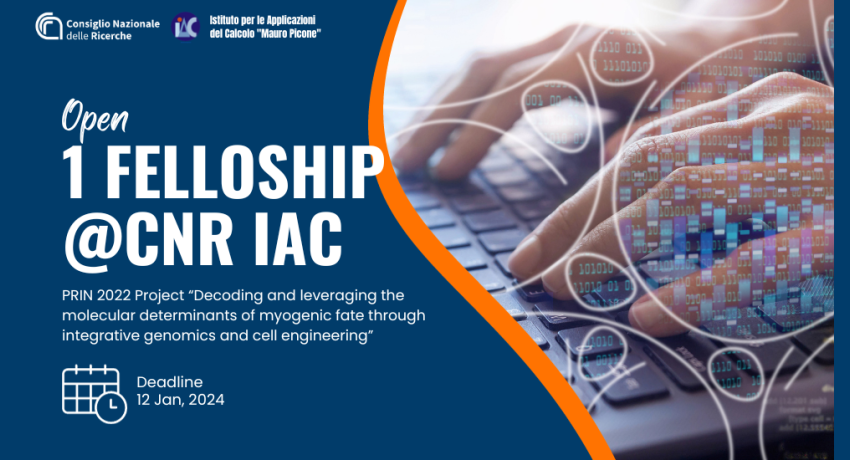
Scade il 12 gennaio la selezione per un assegno di ricerca sul programma 2022T7XP29 “Decoding and leveraging the molecular determinants of myogenic fate through integrative genomics and cell engineering”, finanziato dal PRIN 2022.
La tematica riguarda lo sviluppo di metodi statistici per l’analisi e l’integrazione di dati omici”, sotto la responsabilità scientifica della dott.ssa Annamaria Carissimo.
Requisiti sono:
Sulla CNR Web TV il video della giornata "Ma a che serve la matematica?"
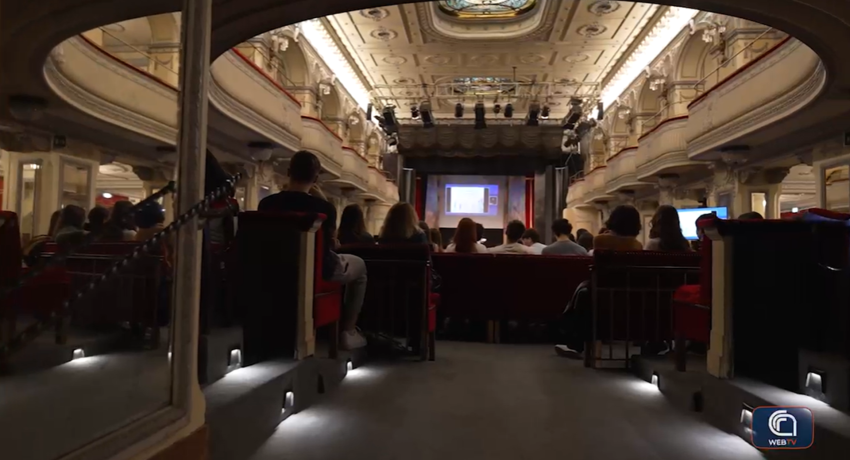
Pubblicato sulla CNR Web TV il servizio sulla giornata del 24 ottobre "Ma a che serve la matematica?" svoltasi a Roma, al Salone Margherita, in collaborazione con il Museo della moneta di Banca d'Italia.
Sul palco, ricercatori dell'IAC e di Banca d'Italia, hanno raccontato agli studenti delle scuole superiori le varie applicazioni della matematica nella vita quotidiana.
Un'occasione per festeggiare i 100 anni del CNR.
Anche l'IAC alla fiera della piccola editoria PLPL 2023
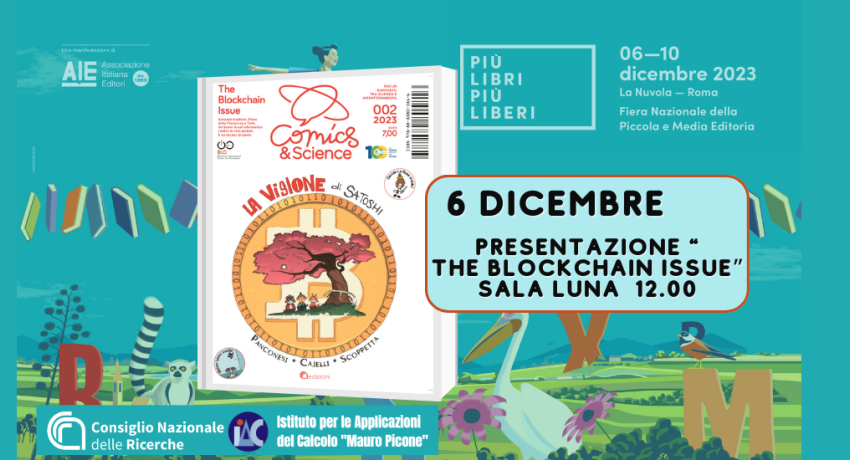
Torna il consueto appuntamento con Più Libri Più Libri, la fiera della piccola editoria che si svolge a Roma al centro congressi La Nuvola dal 6 al 10 dicembre 2023.
Allo stand di CNR Edizioni, stand M24, piano FORUM, ci sarà anche l'IAC, con la sua collana di fumetti scientifici Comics&Science.
Giornata IAC 2023
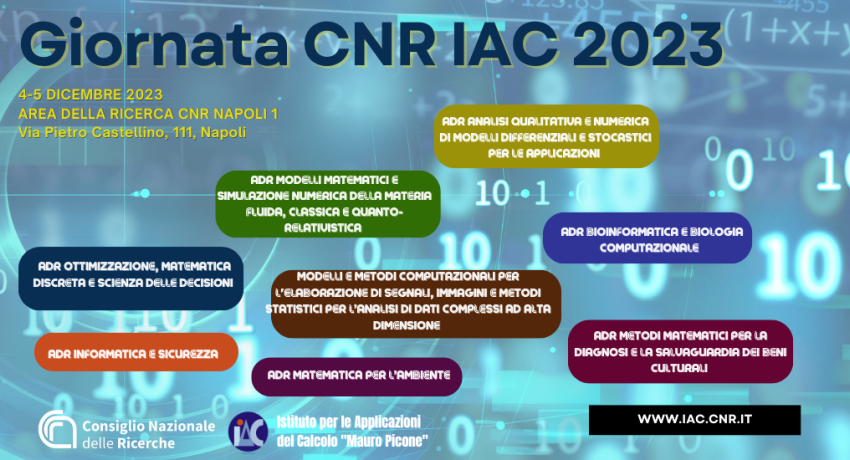
Si svolge a Napoli, all'AdR Napoli1 di Via Castellino 111, la giornata annuale dell'IAC.
Come ogni anno, l'evento permette la condivisione dei principali risultati delle varie Attività di Ricerca dell'istituto tra i ricercatori che operano nelle diverse sedi dell'IAC.
- Read more about Giornata IAC 2023
- Log in or register to post comments