





Computing integrals with an exponential weight on the real axis in floating point arithmetic

The aim of this work is to propose a fast and reliable algorithm for computing integrals of the type $$\int_{-\infty}^{\infty} f(x) e^{\scriptstyle -x^2 -\frac{\scriptstyle 1}{\scriptstyle x^2}} dx,$$ where $f(x)$ is a sufficiently smooth function, in floating point arithmetic. The algorithm is based on a product integration rule, whose rate of convergence depends only on the regularity of $f$, since the coefficients of the rule are ``exactly'' computed by means of suitable recurrence relations here derived. We prove stability and convergence in the space of locally continuous functions

RNASeqGUI: a GUI for analysing RNA-Seq data

Summary: We present RNASeqGUI R package, a graphical user interface (GUI) for the identification of differentially expressed genes across multiple biological conditions. This R package includes some wellk-nown RNA-Seq tools, available at www.bioconductor.org. RNASeqGUI package is not just a collection of some known methods and functions, but it is designed to guide the user during the entire analysis process. RNASeqGUI package is mainly addressed to those users who have little experience with command-line software.

Mathematical Aspects of Geophysical Flows (MathGeo)

This is a two-days event that brings together mathematicians and physicists with a shared interest in exploring the mathematical aspects of geophysical flows. 


The venue of the event is Istituto per le Applicazioni del Calcolo, Consiglio Nazionale delle Ricerche, via dei Taurini 19, 00185 Rome. 


The meeting will start at 10.30am on Thursday, October 12th, 2023, and conclude at 5pm on Friday, October 13th, 2023. 


List of speakers:

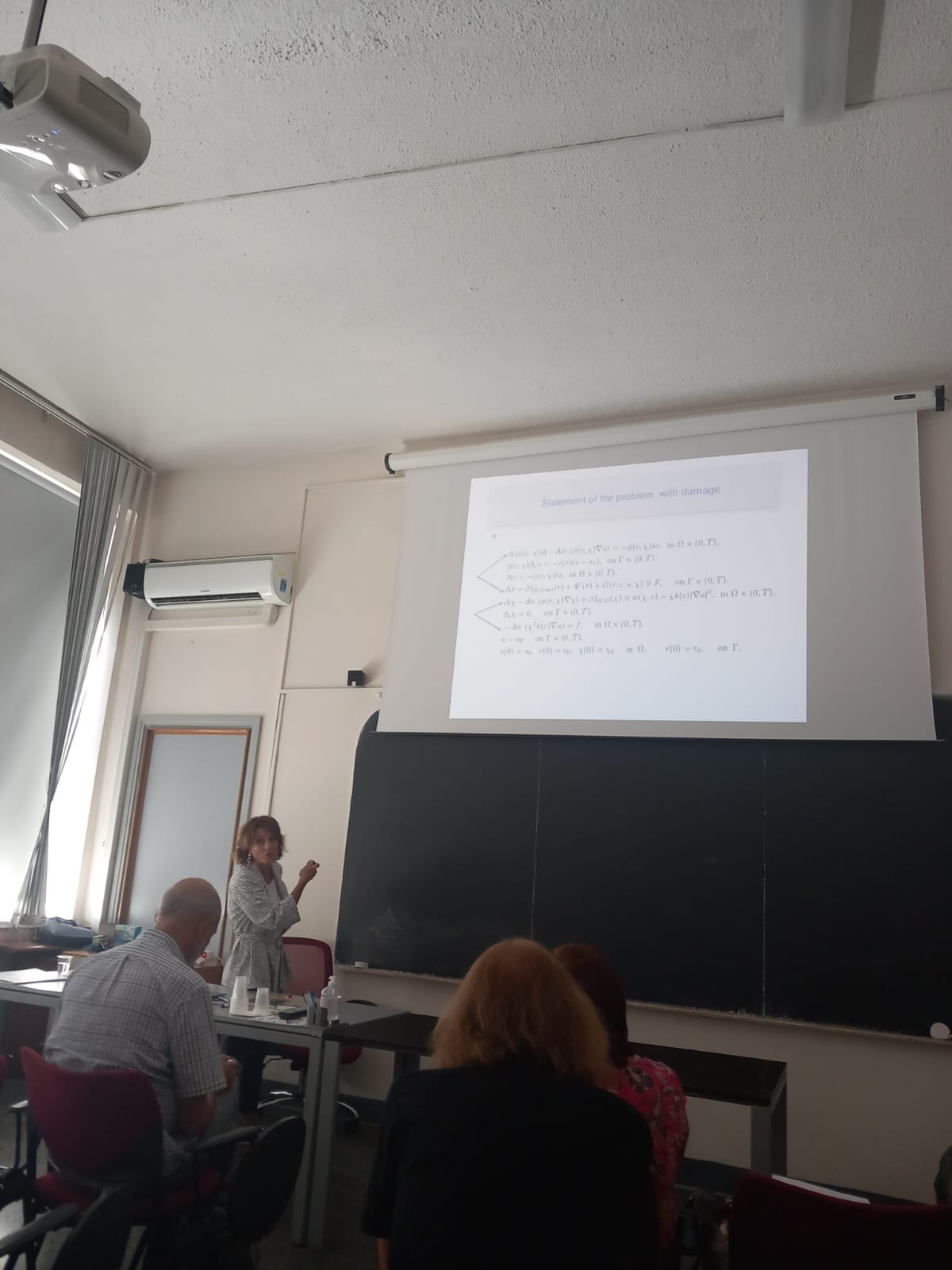
A nonlinear model for marble sulphation including surface rugosity and mechanical damage

Here we propose and analyze a mathematical model that aims to describe the marble sulphation process occurring in a given material. The model accounts for rugosity as well as for damaging effects. This model is characterized by some technical difficulties that seem hard to overcome from a theoretical viewpoint. Therefore, we introduce some physically reasonable modifications in order to establish the existence of a suitable notion of solution on a given time interval. Numerical simulations are presented and discussed, also in view of further research.